
I expected an article about building a game with AI to run long. Once I actually sat down to write, I realized the AI had done all the work — there were few technical details left to share, only the thinking behind them. Technical writing is probably heading this way: ideas first, details shrinking. At least at the application layer.
A few years ago I started looking for an offline Three Kingdoms strategy game, the kind I played on the PlayStation as a kid — something to pick up for a quick round in spare moments.
Searching the App Store for Three Kingdoms returned piles of mobile games, every one with Three Kingdoms in the title and gacha mechanics inside. I'd search, close the app, remember a few weeks later, and search again. That's how the last few years went.
Eventually I got tired of waiting. If no one was going to make it, I'd make it myself.
That turned into a years-long project. I come from front-end web development, but iOS is a different craft, and Swift had to be learned from zero. Work by day, tutorials by night, a bit of coding on weekends. A battle system where troops, supplies, and morale are all tangled together is nothing like building web UI. When my energy ran out, I stopped; each stop lasted half a year, and picking it back up meant rereading old notes to find the thread. The project just hung there — alive, never finished.
When AI's coding ability took off over the past two years, I threw away the old code repository, kept only the design documents, and handed the whole game over to ArDot and WorkBuddy. It wasn't an easy decision — after all that self-study, it meant admitting that road led nowhere. But a dead end is a dead end. I write the requirements and set the direction; WorkBuddy writes the code, ArDot designs the interface.
The energy I saved all went into content. The gameplay is classic Three Kingdoms — turn-based strategy plus management — but somewhere along the design work I started letting my mind wander. One day I wanted Wukong, Yang Jian, and Nezha, those three rebels, descending into the Three Kingdoms to stir things up. The next day I wondered what would happen if the great generals of the Tang dynasty's Lingyan Pavilion marched in to unify the land: Qin Qiong against Lü Bu, Li Jing against Zhou Yu. The ideas kept escalating, and I even built a level pitting the notorious ministers Qin Hui and Zhao Gao against the strategists Guo Jia and Xun Yu — schemers versus strategists, to see who out-thinks whom. Back when I was grinding through the code alone, I never dared to imagine like this; back then the basic logic alone drained everything I had.
I also had the AI build a full game-editing workbench. A lot of the work can be handed to scripts, which saves tokens — see the two screenshots below:
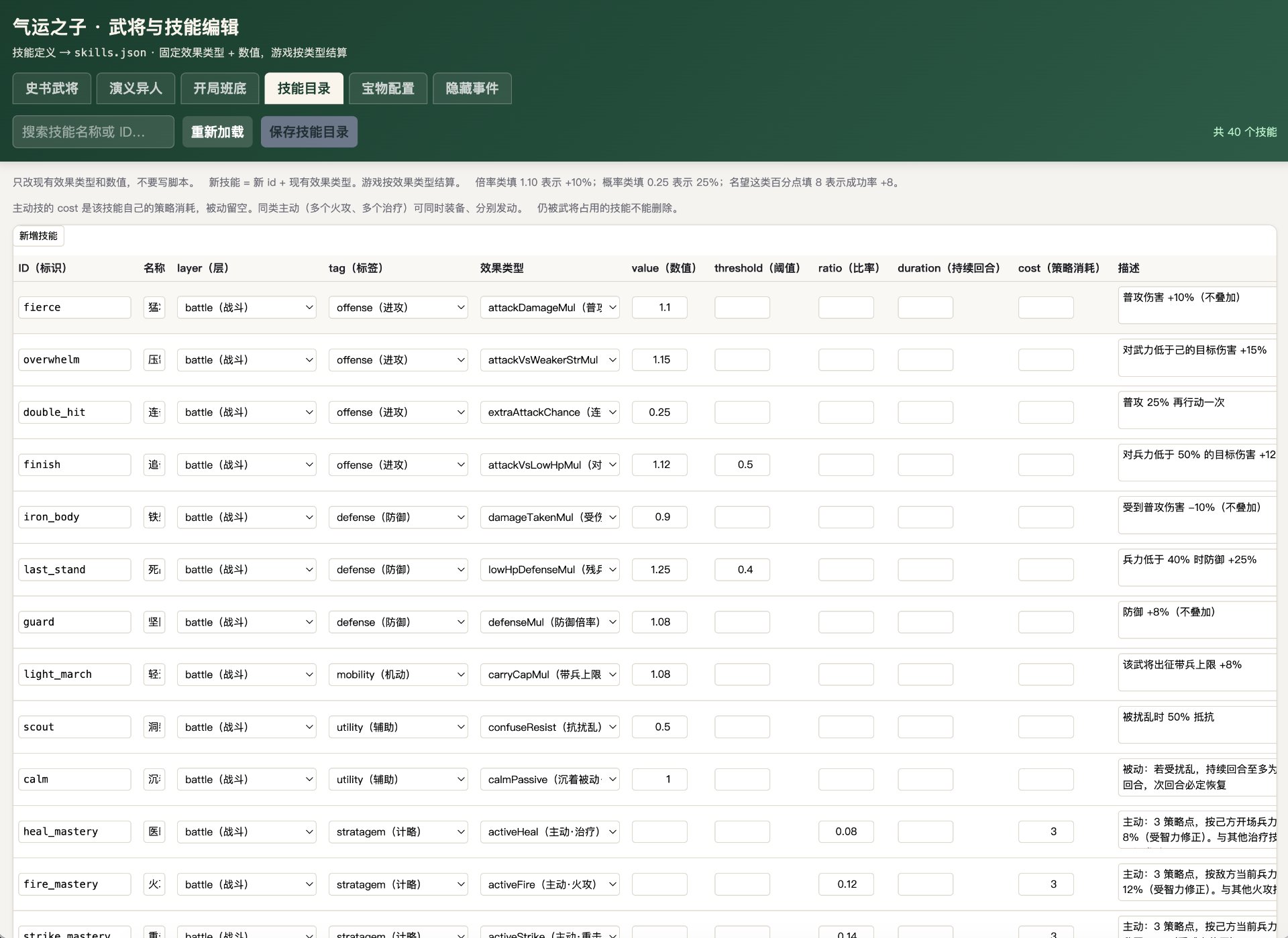
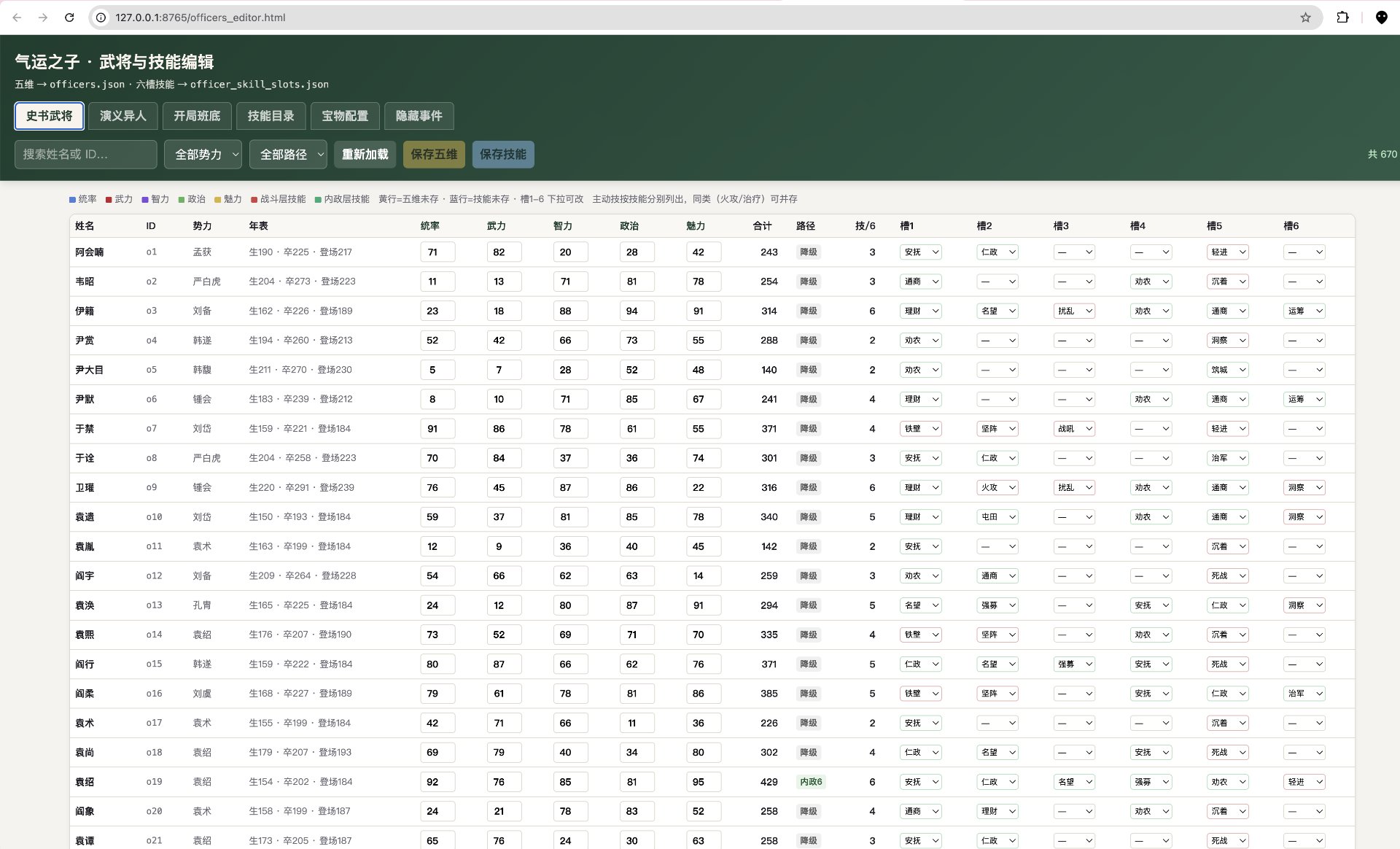
The game is called Son of Fate (气运之子) — a Three Kingdoms strategy and management game where you start from a single city, transported into the Three Kingdoms era. The name comes from its fate system. The music is AI-made too: I wrote a batch of originals with Suno in an ancient-Chinese style, compiled them into an album, and released it on QQ Music. An indie developer owning an original soundtrack used to be unthinkable.
The game is on the App Store — scan the code to download.
The night it launched, I started a new save and played a full round from the beginning. Then I searched the App Store again. Years ago, that search box returned nothing but reskins. Now, searching Son of Fate, the first result is my own game — and I can keep developing it however I want to play.
Want to know more about the game itself? See the full introduction page.

Download Son of Fate
App Store · One-time purchase · No gacha